
By Steph Orme, Ph.D., UX Research Manager, Key Lime Interactive
For decades, brand loyalty was protected by high switching costs—things like physical infrastructure, restrictive contracts, or a simple lack of alternatives. Once a customer found something that worked well enough, sticking with it was easier than finding a replacement.
Long-standing relationships and goodwill were usually enough to earn customers’ forgiveness for a clunky UI or poor performance.
But loyalty is fragile when options are endless.
In today’s diverse marketplace of digital products, users don’t have to settle for painful experiences anymore. According to a PricewaterhouseCoopers survey of over 15,000 consumers across 12 countries, 32% of respondents said they will stop interacting with a brand they love after just one negative experience. In Latin America, that number jumps to 49%.
When the stakes are this high, where should product and research teams be focusing their energy?
1. Focus Your Research on Onboarding
In the race against user retention, it’s easy to panic and run broad usability studies to figure out where users are falling off. However, drop-off often happens before users even really begin: during the onboarding experience.
The High-Investment Trajectory Problem
Health and fitness brands, in particular, fall into an unfortunate pattern. In an attempt to hyper-tailor the experience, many require new users to:
- Create a full account
- Provide sensitive personal data
- Grant device permissions
- Answer lengthy questionnaires
All before the user can even determine if the experience is valuable.
The Imbalance: The product demands a high upfront investment—privacy, time, and effort—before offering any proof of value. Users are forced to trade sensitive data on pure faith.
If they make it through the setup only to find a lackluster experience, they feel cheated of their time—and the app gets deleted before it’s ever really used.
The Better Approach: Delay the Friction
Uber Eats cracked the code by flipping this model on its head with their app. They only require users to sign up when they are ready to pay for their first order. Their model is:
- Browse First: Users explore restaurants and build their order without an account.
- Convert Second: Account creation is only prompted at checkout.
Because users have already seen the value and intend to make a purchase, registering feels like the logical final step to get what they want—not an annoying chore.
Giving users an early win before or during onboarding builds goodwill and drastically lowers the risk of alienating them early on.
2. Stop Confusing Excitement with Actual User Demand
A common trap for product teams in a rush to ship features is confusing internal excitement with genuine user demand. Teams fall in love with a concept, make assumptions based on competitors, and go straight to building—without validating if the feature actually solves a problem users care about.
Then, launch day arrives, and user feedback sounds like:
- “My current process works just fine.”
- “Why would I use this instead of what I already do?”
The “9x-10x Better” Rule
This disconnect stems from an assumption that if a new feature is 10% better, users will adopt it. But users are inherently resistant to switching.
In a landmark Harvard Business Review article, Dr. John Gourville (Professor of Business Administration at Harvard Business School) identified a massive psychological gap between product creators and users:
- Creators overvalue the benefits of a new feature by 3x its objective value.
- Users overvalue their existing tools and habits by 3x.
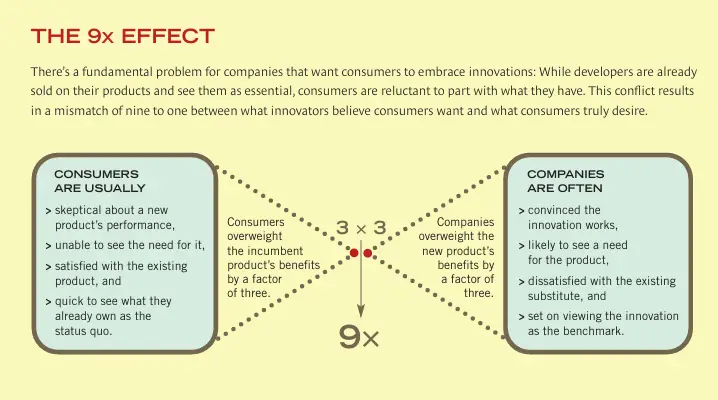
To compel users to ditch their old tools, a new solution needs to be 9 to 10 times better than what they currently use. Convenience, familiarity, and trust create heavy inertia. When a user says their current approach works, you aren’t just missing a feature—you are trying to alter deeply ingrained behavior.
Key Takeaways
Users don’t always abandon products simply because they lack features; they abandon them because the effort outweighs the payoff.
To build lasting digital loyalty:
- Lower the barrier to an early win to prove your product’s value as quickly as possible.
- Validate real demand to ensure the problems you are solving are ones your users actually care about.